

WB5000 Series: SiC Bidirectional DC Power for Next-Generation New Energy Testing
Release time: 2026-11-09
As 800V platforms, high-power electric drive systems, EV charging, and energy storage PCS continue to evolve, testing requirements are becoming increasingly demanding.
For engineers, the challenge is no longer simply to provide stable DC power. Modern test benches need to accurately reproduce dynamic battery behavior, respond to fast transients, recover energy efficiently, and integrate seamlessly with automated testing systems.
Yet many laboratories still rely on physical batteries or conventional DC source + electronic load configurations. These approaches can create limitations in test repeatability, energy consumption, system footprint, and dynamic performance.
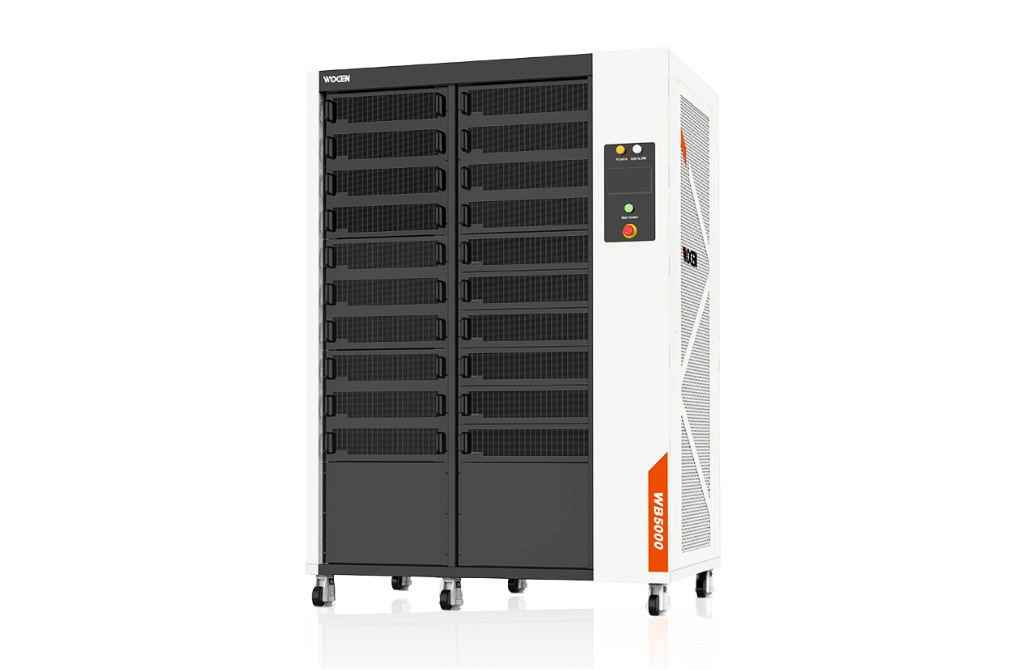
The Wocen Power WB5000 Series Bidirectional DC Test Power Supply is designed to address these challenges with a high-frequency SiC architecture, four-quadrant operation, professional battery simulation, and modular system design.
Why Traditional Test Power Solutions Are Becoming Challenging
Physical batteries provide real-world characteristics, but they also introduce variables that are difficult to control.
Battery aging, SOC drift, temperature changes, and differences between battery packs can affect test results. Reproducing exactly the same battery condition for repeated tests is therefore difficult.
For long-duration cycling or fault-injection testing, physical batteries can also increase safety risks, laboratory space requirements, and operating costs.
Another common configuration is a separate DC power supply + electronic load. While effective for basic testing, it may not provide sufficiently fast transitions between charging and discharging states.
This becomes particularly important when testing electric drive systems, where the battery-side power can change rapidly during acceleration and regenerative braking.
Meanwhile, in conventional high-power endurance testing, energy returned from the DUT is often dissipated as heat. The result is higher electricity consumption and increased cooling requirements.
Long cable runs introduce another challenge. Cable impedance can cause voltage drops between the power supply and the DUT, creating differences between the programmed output and the actual voltage at the test terminals.
These challenges are driving demand for more integrated and intelligent test power solutions.
SiC Technology for High-Dynamic Testing
The WB5000 Series adopts third-generation SiC wide-bandgap semiconductor technology and a high-frequency digital four-quadrant control architecture.
This enables a combination of:
- High power density
- Fast transient response
- Bidirectional power flow
- High-efficiency regenerative operation
- High-precision battery simulation
- Modular power expansion
With transient response down to 500 μs, the WB5000 can respond rapidly to changing DUT conditions and achieve seamless transitions between charging and discharging quadrants.
This is particularly useful for simulating dynamic conditions such as vehicle acceleration, regenerative braking, EV charging transients, and PCS power disturbances.
The compact SiC architecture also helps reduce equipment footprint, making it suitable for laboratories where test-bench space is limited.
Replace Physical Batteries with Flexible Battery Simulation
One of the key capabilities of the WB5000 is its built-in battery simulation function.
The system includes five standard battery models:
LFP, NMC, LMO, LCO, and Lead-Acid
It also supports five user-defined I-V characteristic curves, allowing engineers to create customized battery models for different testing requirements.
Parameters such as battery series/parallel configuration and initial SOC can be configured according to the test scenario.
Instead of repeatedly preparing physical battery packs, engineers can recall predefined battery conditions and reproduce the same test parameters.
This can improve test repeatability while reducing the space, maintenance, and safety requirements associated with physical batteries.
Four-Quadrant Operation with Energy Regeneration
The WB5000 supports four-quadrant bidirectional operation, allowing energy to flow in both directions between the power supply and DUT.
During regenerative operation, energy returned from the DUT can be fed back into the grid rather than being converted into heat.
With overall efficiency of >95%, this regenerative architecture can help reduce energy consumption and cooling loads during long-duration testing.
For applications involving repeated charge/discharge cycles, aging tests, and regenerative braking simulation, energy recovery can become an important part of overall laboratory efficiency.
High-Precision Output with Cable Compensation
For high-power test benches, the electrical conditions at the DUT terminals can be just as important as the output settings of the power supply.
The WB5000 provides voltage and current accuracy of up to ±0.02% F.S.
It also incorporates an automatic cable voltage-drop compensation algorithm.
By entering the output cable impedance, the system can compensate for voltage drops caused by long cables, helping maintain accurate voltage conditions at the DUT terminals.
This is especially useful for high-power test setups where the distance between the power supply and DUT can introduce significant wiring-related errors.
Modular Architecture for Easier Maintenance and Expansion
The WB5000 uses a drawer-type modular power architecture.
If a power module requires maintenance, it can be quickly removed and replaced on site, helping reduce system downtime.
The system also supports same-model master-slave paralleling, enabling flexible power expansion without replacing the entire system.
The platform supports:
12–2000 V | ±1200 A | Up to 600 kW
This allows the same testing architecture to adapt as project power requirements increase.
For laboratories supporting multiple generations of test projects, this modular approach can provide greater flexibility for future expansion.
Designed for Automated Test Systems
Modern test benches are increasingly automated, particularly in automotive and power electronics R&D.
The WB5000 provides RS485, Ethernet, and CAN communication interfaces and supports DBC files for system integration.
It can be integrated with:
- HIL systems
- Automated test platforms
- High-voltage test benches
- R&D validation systems
- Endurance and cycling test systems
The system also includes several functions designed to improve operational safety and troubleshooting efficiency.
Black-Box Fault Recording
Operating electrical parameters before and after alarm events can be automatically recorded.
For intermittent or unexpected test-bench faults, these records provide traceable data that can help engineers identify the cause of an issue more efficiently.
Output Parameter Limits
Voltage, current, and power limits can be configured to reduce the risk of incorrect operation and provide additional protection for valuable DUTs.
High-Voltage Protection
The system provides multi-level protection for conditions including input phase loss, overvoltage/undervoltage, output overcurrent, short circuit, and SiC module overtemperature.
Optional discharge functionality can also rapidly reduce residual high voltage after shutdown.
Applications Across New Energy Testing
The WB5000 Series can support a wide range of high-voltage testing applications.
Electric Vehicle Testing
Suitable for testing:
- Electric drive systems
- Motor controllers
- BMS
- OBC
- DC-DC converters
The system supports testing requirements across 400V and 800V platforms.
EV Charger Testing
For AC/DC EV chargers and charging power modules, the WB5000 can simulate different battery conditions and reproduce dynamic charging and disturbance scenarios.
Energy Storage PCS Testing
The system can simulate battery charge/discharge behavior for PCS testing, including grid-connected operation, off-grid operation, power dispatch, and power disturbance scenarios.
Research & Third-Party Testing
The WB5000 can also be integrated into university laboratories, research institutions, and third-party testing facilities for power electronics research, validation, and HIL testing.
Building a Complete High-Voltage Test System
Beyond the DC power supply itself, Wocen Power can provide optional components for building a more complete high-voltage test environment, including:
PDU Connection Boxes for high-voltage distribution, voltage acquisition, interlock protection, and emergency stop functions.
Discharge Cabinets for safely removing residual high voltage after faults or shutdown.
Capacitor Cabinets for improving output stability during rapid load changes.
Insulation Monitoring Systems for continuously monitoring insulation resistance and providing early warnings when insulation performance deteriorates.
Together, these components help create a more integrated and safety-oriented high-voltage test platform.
A More Flexible Approach to New Energy Testing
As new energy systems move toward higher voltage, higher power, and faster dynamic response, test power supplies are becoming an increasingly important part of the R&D infrastructure.
The WB5000 Series combines SiC technology, bidirectional four-quadrant operation, battery simulation, energy regeneration, high-precision output, and modular architecture into one testing platform.
From electric drive systems and BMS validation to EV charging and energy storage PCS testing, it is designed to provide a flexible and repeatable power foundation for next-generation power electronics testing.
Wocen Power focuses on the R&D and manufacturing of power test equipment and customized power testing solutions.
With the WB5000 Series, we continue to explore how advanced power electronics technology can make testing more precise, more efficient, and more adaptable.
Interested in the WB5000 Series? Contact Wocen Power for the product datasheet, technical specifications, or sample testing consultation.