

Smarter OBC & DCDC Testing: AC Simulation, DC Power & Energy Recovery
Release time: 2026-10-10
As electric vehicles continue to evolve toward higher voltage and power levels, On-Board Chargers (OBCs) and DC-DC converters (DCDCs) are becoming increasingly important in vehicle power architectures.
Their efficiency, stability, dynamic response, and electrical safety must be thoroughly validated throughout R&D and production testing. At the same time, test systems need to simulate realistic electrical conditions while maintaining high accuracy and energy efficiency.
This is where a flexible test power architecture becomes essential.
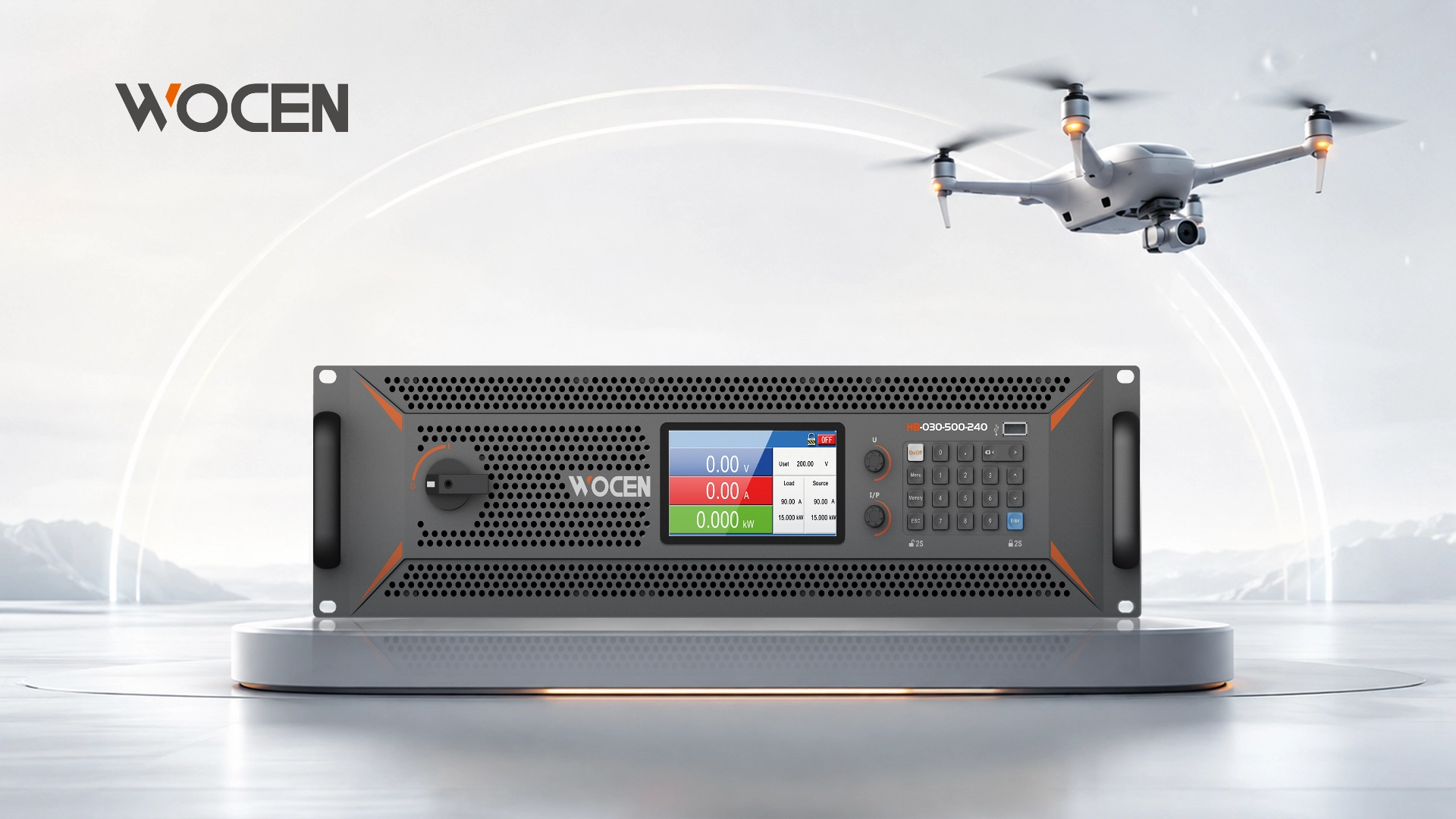
Wocen Power combines AC grid simulation, programmable DC power, bidirectional loading, and regenerative energy recovery to provide integrated test solutions for OBC and DCDC testing.
Key Testing Challenges
Modern OBC and DCDC testing requires test power systems that can provide:
- Accurate voltage and current simulation
- Fast dynamic response
- Stable and low-ripple output
- Flexible operating modes
- Bidirectional energy flow
- Regenerative operation for energy recovery
Traditional power sources and non-regenerative loads may require separate equipment for different test conditions and can result in significant energy dissipation during long-duration testing.
An integrated AC and DC test power system provides a more flexible approach.
OBC Testing Solution
The OBC converts AC power from the charging infrastructure into DC power for the vehicle's high-voltage battery.
As OBC power levels continue to increase—from earlier single-phase systems to three-phase 11 kW and 22 kW solutions—comprehensive testing of input characteristics, conversion performance, dynamic response, protection functions, and efficiency becomes increasingly important.
Typical OBC Test Architecture
AC Grid Simulation → OBC → Bidirectional DC Load
The Wocen WA Series Regenerative Grid Simulator can simulate the AC grid or charging infrastructure on the input side of the OBC.

On the DC side, the Wocen HB Series Bidirectional Programmable DC Test Power Supply can operate as a controllable DC load, simulating the high-voltage battery during charging tests.

The test system can also be integrated with oscilloscopes, power analyzers, and automated test software for comprehensive electrical performance evaluation.
Bidirectional OBC Testing
For reverse power or inverter-related tests, the configuration can be reversed:
Bidirectional DC Source → OBC → AC Grid Simulation
The HB Series can simulate the high-voltage battery as a programmable DC source, allowing engineers to reproduce different battery voltage and operating conditions without using an actual battery pack.
With different voltage and power configurations, Wocen's bidirectional DC test power supplies can support a range of high-voltage automotive platforms, including 400 V and 800 V systems.
DCDC Testing Solution
DCDC converters play a critical role in EV electrical systems by converting high-voltage DC power from the traction battery into low-voltage DC power for vehicle auxiliary systems.
Testing therefore needs to cover input/output characteristics, conversion efficiency, voltage regulation, dynamic response, protection functions, and operation under different load conditions.
Typical DCDC Test Architecture
Programmable DC Source → DCDC → Bidirectional DC Load
The programmable DC test power supply simulates the vehicle's high-voltage battery and provides a controlled input to the DCDC.
On the output side, a Wocen bidirectional programmable DC power supply can operate as a controllable load, simulating low-voltage vehicle electrical systems or an auxiliary battery.
Regenerative DC Loading
During DCDC testing, the output energy from the DUT needs to be absorbed by the load.
Instead of dissipating this energy as heat, a bidirectional regenerative DC power supply can recover the energy and return it to the grid.
This approach can help:
- Reduce energy consumption
- Reduce heat dissipation
- Improve long-duration test efficiency
- Lower test operating costs
One Integrated Platform for Multiple Test Scenarios
By combining AC grid simulation, programmable DC power, bidirectional loading, measurement equipment, and test software, engineers can build flexible test platforms for different automotive power electronics.
OBC Testing
WA Series AC grid simulation → OBC → HB Series Bidirectional DC source / load
DCDC Testing
Programmable DC Test Power Supply High-voltage battery simulation → DCDC → HB Series Bidirectional DC loading & energy recovery
This architecture enables engineers to reproduce different voltage, current, power, and operating conditions while supporting automated testing and energy-efficient operation.
From Power Simulation to Efficient Testing
As automotive power electronics move toward higher voltage, higher power density, and greater integration, test systems need to become more flexible and efficient.
An integrated AC and DC test power architecture enables engineers to:
Simulate realistic electrical conditions
Test dynamic operating scenarios
Control bidirectional energy flow
Recover energy during testing
From OBC charging and reverse-power testing to DCDC conversion and regenerative loading, Wocen Power provides flexible test power solutions for the development and production testing of modern automotive power electronics.
Wocen Power - Precision Power for Every Test.