

Regenerative Grid Simulator for PV Inverter and Energy Storage Testing
Release time: 2026-11-24
As renewable energy continues to expand, photovoltaic (PV) inverters and energy storage systems are playing an increasingly important role in modern power grids. Ensuring their performance, grid compatibility, and operational reliability requires comprehensive testing under various electrical conditions.
A regenerative grid simulator provides a flexible and efficient testing solution by reproducing complex grid conditions, supporting four-quadrant operation, and enabling energy regeneration. It is widely used in PV inverter testing, energy storage PCS testing, and other power electronics applications.
1. PV Inverter Testing: Simulating Real-World Grid Conditions
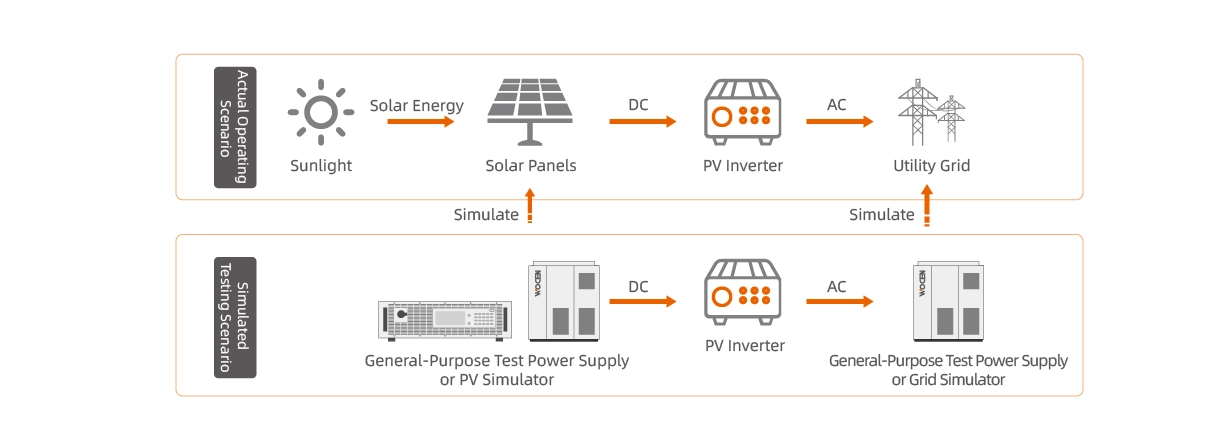
PV inverters convert the DC power generated by solar panels into AC power for grid connection. Their ability to operate reliably under different grid conditions is essential for maintaining power quality and grid stability.
A regenerative grid simulator provides a controlled testing environment by reproducing various grid conditions, including voltage and frequency fluctuations, weak grid conditions, high/low voltage ride-through (HVRT/LVRT), zero-voltage ride-through (ZVRT), harmonic injection, and three-phase voltage unbalance.
These capabilities allow engineers to evaluate inverter grid adaptability, anti-islanding protection, active and reactive power regulation, and fault ride-through performance.
Energy regeneration is another important advantage. Unlike conventional dissipative testing methods, a regenerative grid simulator can feed electrical energy back into the grid, reducing energy consumption and heat generation during long-duration testing and aging processes.
2. Energy Storage PCS Testing: Bidirectional Power Simulation
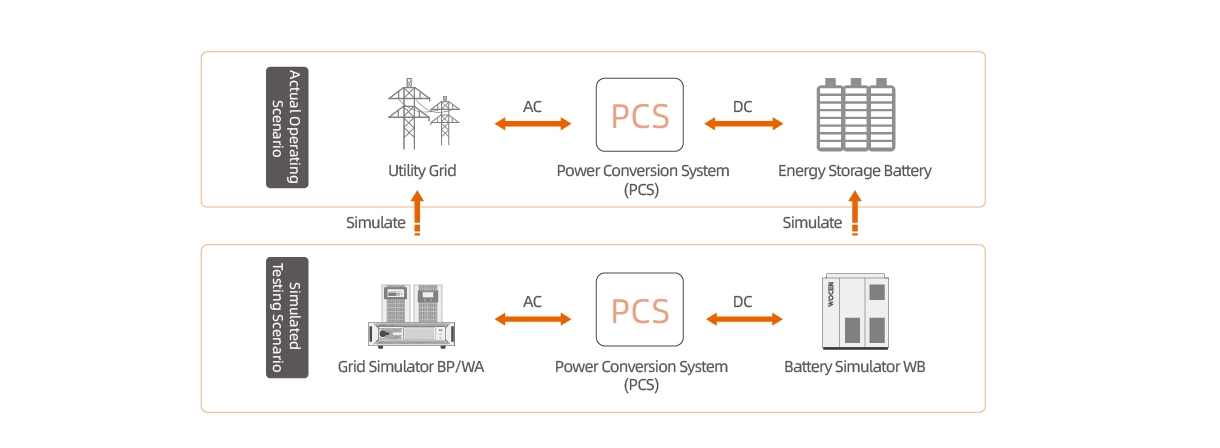
Energy storage systems rely on Power Conversion Systems (PCS) to manage bidirectional energy conversion between battery systems and the electrical grid.
Since PCS equipment operates in both charging and discharging modes, comprehensive testing requires flexible bidirectional power capabilities and accurate grid simulation.
A regenerative grid simulator can reproduce grid voltage and frequency variations, grid faults, islanded operation, and grid reconnection scenarios. These tests help engineers evaluate PCS grid adaptability, power response, conversion efficiency, harmonic performance, and protection functions.
Combined with bidirectional DC power supplies and battery simulators, it enables comprehensive testing of energy storage converters from both AC and DC sides.
3. Testing Throughout the R&D and Production Process
Both PV inverters and energy storage PCS require comprehensive testing throughout product development and manufacturing.
R&D and Design Validation
During prototype development, manufacturers need to verify electrical performance, control functions, and compliance with relevant standards.
For PV inverters, programmable DC power supplies or PV array simulators reproduce solar panel output characteristics, while regenerative grid simulators reproduce different grid conditions.
For energy storage PCS, battery simulators reproduce battery charge and discharge characteristics, while grid simulators evaluate AC-side performance under various operating conditions.
Production and Quality Assurance
After assembly, products undergo functional testing, factory testing, performance verification, aging screening, and grid adaptability testing.
Programmable and repeatable test conditions help manufacturers improve production consistency, identify potential issues, and ensure product reliability before delivery.
4. Wocen Power WA Series Regenerative Grid Simulator
The Wocen Power WA Series Regenerative Grid Simulator adopts third-generation wide-bandgap semiconductor SiC technology, delivering high precision, fast dynamic response, and high efficiency.
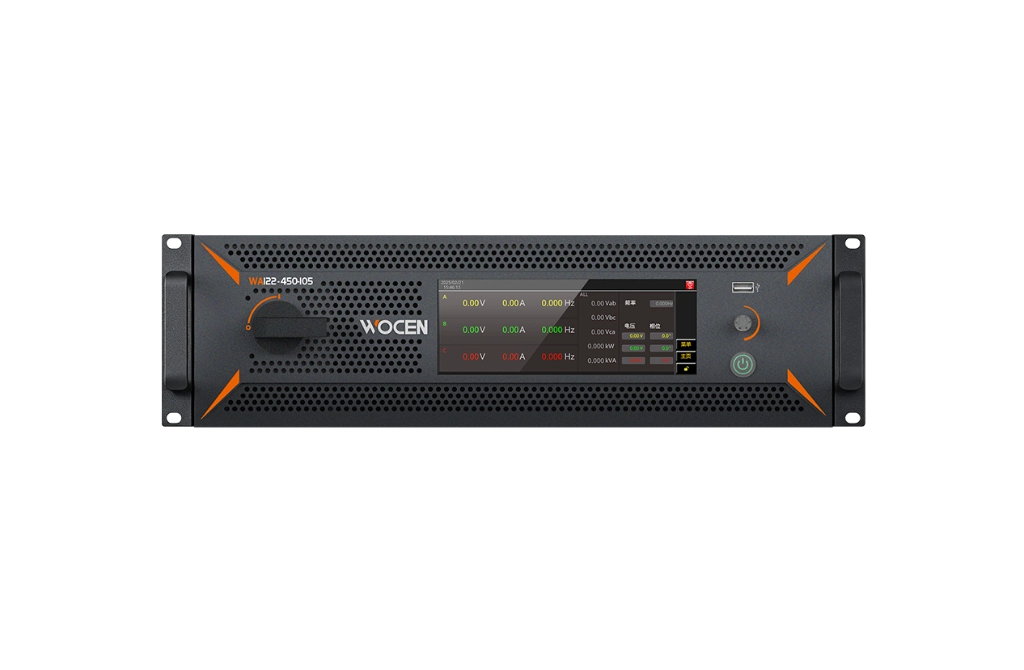
More than a conventional grid simulator, the WA Series is a multifunctional bidirectional AC source and load platform integrating four functions:
- Programmable AC Power Source
- Regenerative Grid Simulator
- DC Power Source
- Regenerative AC Electronic Load
It features a built-in standard waveform library for photovoltaic, energy storage, and new energy vehicle testing. Users can also customize waveforms according to specific testing requirements.
With selectable single-phase and three-phase operating modes, the WA Series offers flexibility for different power electronics testing scenarios.
Key Features:
- Third-generation SiC technology
- Four-quadrant bidirectional operation
- Integrated AC source, grid simulator, DC source, and regenerative AC electronic load
- Built-in standard and customizable waveform library
- Single-phase and three-phase operating modes
- Energy regeneration for improved testing efficiency
Together with Wocen Power's WB5000 and HB Series Bidirectional DC Test Power Supplies, the WA Series provides flexible AC and DC testing capabilities for PV inverters, energy storage PCS, and other power conversion equipment.
Conclusion
As photovoltaic generation and energy storage technologies continue to evolve, reliable testing is essential for ensuring grid compatibility, power conversion efficiency, and long-term operational stability.
With advanced SiC technology, four-quadrant operation, flexible waveform simulation, and energy regeneration, the Wocen Power WA Series provides an efficient testing solution for renewable energy power electronics.
From R&D validation to production testing, Wocen Power supports manufacturers with reliable and flexible test power solutions.