

Industrial UAV Onboard DC-DC Converter Test Solution
Release time: 2026-10-22
Focusing on the core power systems of industrial drones (such as tethered inspection drones, multi‑rotor operation drones, and fixed‑wing mapping drones), we conduct factory performance calibration, batch quality screening, reliability verification, and fault pre‑diagnosis testing for the power module consisting of propellers, motors, and electronic speed controllers. This system adapts to the power output requirements of drones under various operating conditions, including takeoff, cruising, hovering, and emergency landing. This system addresses issues such as poor power module compatibility, weak load tolerance, and unstable efficiency during long‑duration operations and complex flight environments, ensuring the coordinated reliability of the power system and the entire drone.
Test Items
No‑load test, locked‑rotor test, back‑EMF test, loading test, dynamic response test, durability test, aging test, etc.
Test Standards
3.1 National standards and industry basic standards
It complies with the test specifications of GB/T 38948‑2020, "General Requirements for Power Systems of Civil Unmanned Aircraft Systems," which require "power module efficiency ≥ 85%, steady‑state operating voltage fluctuation ≤ ±5%, and overload protection response time ≤ 100ms." It also follows the general requirements for industrial UAV power system safety testing to ensure that test results meet the flight safety standards for the entire UAV.
3.2 BLDC Test System Specifications
Drawing on the "Functional Integrity Verification Standard" of the BLDC (Brushless DC Motor) complete machine comprehensive test system, the system ensures that the coordinated functional testing of the ESC, motor, and propeller covers all scenarios, including start‑stop, speed regulation, and commutation. Referring to the "Dynamic Load Test Specification" of the BLDC (Brushless DC Motor) complete machine loading test system, the system meets the performance test requirements of the power module within the rated load range of 0‑120%, adapting to the industry test indicators of BLDC motor drive systems.
Test plan
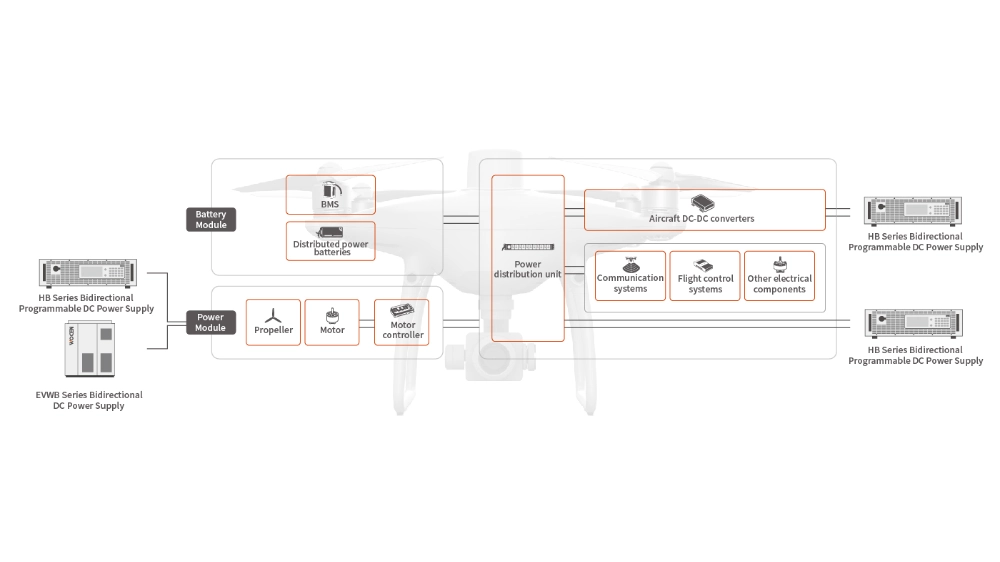
Bidirectional DC test power supply: Serves as the power module's energy input, simulating the voltage characteristics of a drone's power battery (e.g., wide‑range adjustable voltage).
Electronic Speed Controller (ESC): Connects the test power supply to the motor, receives flight control signals (e.g., PWM speed control commands), and is responsible for motor speed control and power distribution, serving as the test system's "energy conversion hub."
Motor and propeller: The motor and propeller form the power actuator. During testing, their synergistic performance must be monitored (e.g., the matching of motor torque and propeller thrust).
Multi‑dimensional Monitoring Module: Collects power supply input parameters (voltage, current, power), motor operating parameters (speed, torque, winding temperature rise), and propeller aerodynamic parameters (thrust, pull, speed), and simultaneously uploads the data to the control system.
Overload Capacity Test: While the bidirectional DC test power supply maintains stable voltage, the ESC drives the motor to 1.2 times the rated load (e.g., by increasing propeller resistance through a load device). The motor temperature rise (e.g., required to be ≤80℃) and the ESC protection response time (e.g., required to be ≤100ms) are monitored to verify the power module's extreme tolerance.